
Looking at the current AI landscape, I can’t shake the feeling we’re riding a wave that might be cresting. The money flowing into this sector is staggering. Every week brings news of another multi-billion dollar investment, another chip shortage, another startup valued at unicorn status before it even has real revenue.
But here’s what caught my attention: the relationship between OpenAI and Oracle.
The OpenAI-Oracle Loop
Think about this cycle for a minute. OpenAI commits to spending $300 billion on Oracle’s cloud infrastructure for training and running their models. That’s not a typo. Three hundred billion dollars.
Oracle’s stock price shoots through the roof on this news. Larry Ellison briefly overtakes Elon Musk and Jeff Bezos as the world’s richest person. That stock surge creates more capital for Oracle, which they can pump back into building data centers and AI infrastructure.
More infrastructure means OpenAI can scale even bigger, which justifies more spending, which drives Oracle’s value higher, which creates more capital for expansion.
Sam spends, Larry gains, capital expands, AI scales, repeat.
It’s a perfect flywheel. Until it isn’t.
The Flywheel: OpenAI + Oracle
- OpenAI commits to spend $300 billion on Oracle cloud infrastructure for training and running its models (CNET, 2025).
- Oracle’s stock price rockets. Larry Ellison briefly becomes the world’s richest person, surpassing Elon Musk and Jeff Bezos (USA Today, 2025).
- That stock surge unlocks even more capital for Oracle, which can be reinvested into data centers and AI infrastructure.
- More infrastructure enables OpenAI to scale further, reinforcing the cycle.
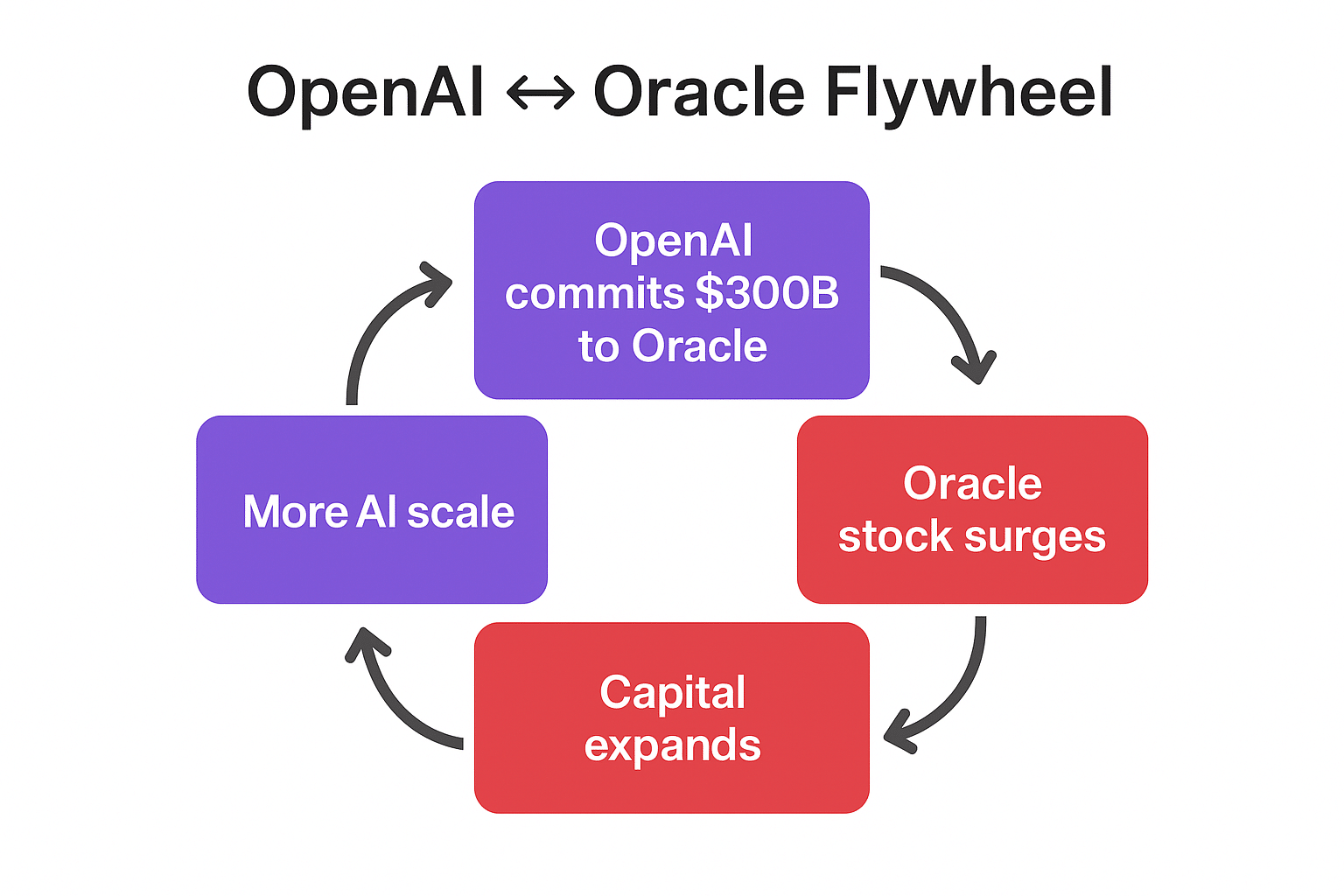
This is the loop: Sam (OpenAI) spends → Larry (Oracle) gains → capital expands → more AI scale → repeat.
But what happens when the loop is built on heavy leverage?
Oracle’s Debt Problem
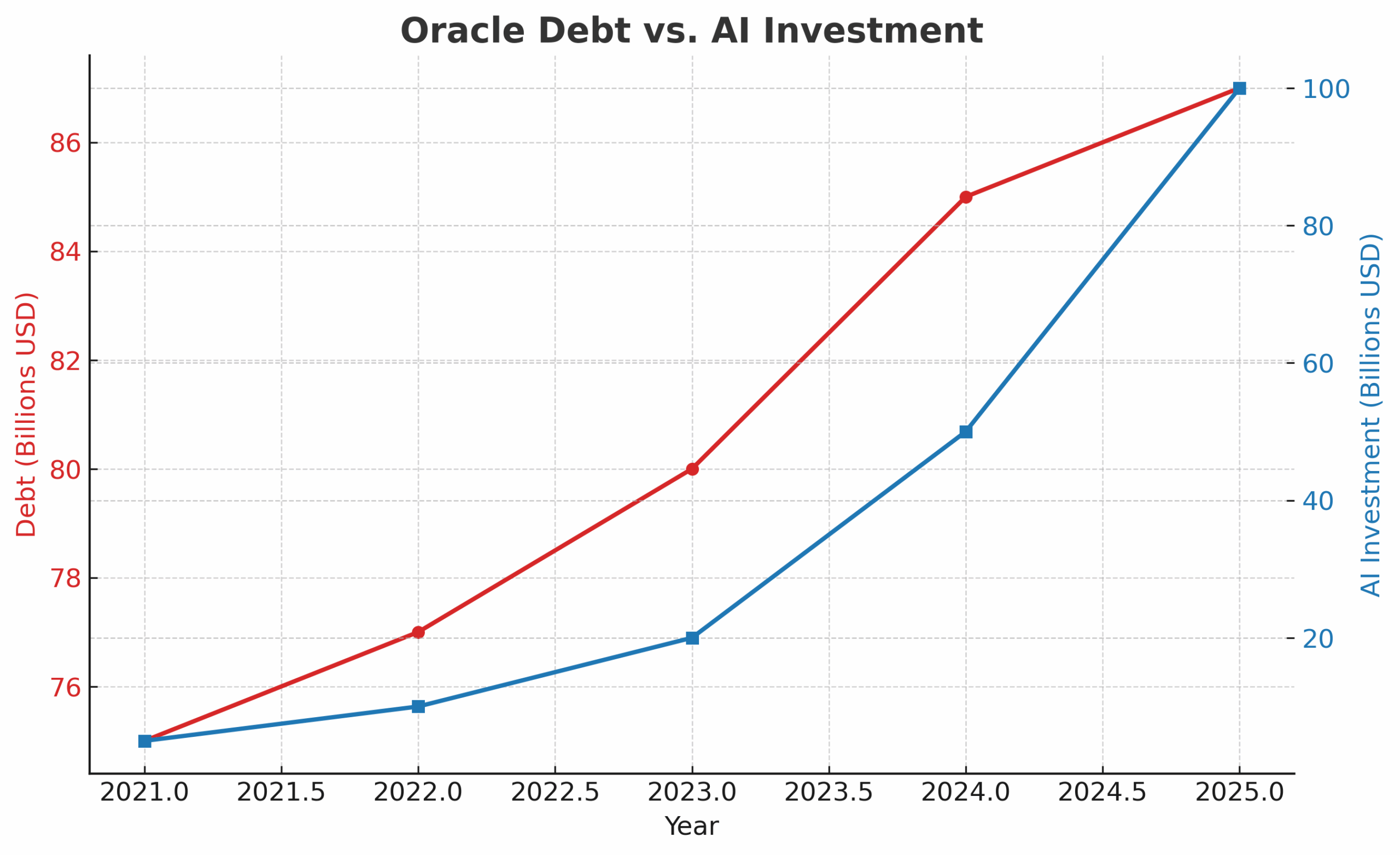
Oracle is carrying tens of billions in long-term debt. As of mid-2025, the company reported over $87 billion in debt obligations (Reuters, 2025). At the same time, it is promising to spend huge sums building new AI-optimized data centers.
That means much of this AI boom rests on borrowed money. If demand softens or margins compress, the flywheel can stall, leaving Oracle with debt it can’t easily service.
Other Signs of a Bubble
Oracle isn’t alone. Across the AI landscape, similar dynamics are playing out:
- Nvidia briefly became a $3 trillion company in 2024, powered almost entirely by demand for its GPUs. The valuation implied years of uninterrupted growth, even though supply chain constraints and competition are real risks (Bloomberg, 2024).
- Microsoft has poured over $13 billion into OpenAI while layering AI into nearly every product. That’s a massive bet that enterprise adoption will stick (WSJ, 2024).
- Anthropic, another AI startup, has raised billions from Google, Amazon, and others, but its revenues remain a fraction of the hype (FT, 2025).
When capital chases growth at this speed, history suggests corrections follow.
Bubble or Just Acceleration?
None of this is to say AI is fake, or that demand isn’t real. The technology is transformative. But the scale of capital flowing into the sector, and the way financial flywheels amplify valuation, looks like classic bubble territory.
The real risk is capacity maxing out before profits catch up. If every cloud provider builds for infinite AI demand, but customers don’t scale at the same pace, debt and valuations could unwind fast.
Where We Stand
We might not be at the absolute peak yet, but the warning signs are flashing bright red. The OpenAI-Oracle relationship shows how quickly hype and capital can reinforce each other. Add Oracle’s debt load, Nvidia’s sky-high valuation, and billions pouring into AI startups with minimal revenue, and you have to ask: are we approaching maximum bubble capacity?
The technology will survive and thrive long-term. But the financial dynamics around it right now look unsustainable. When the correction comes, it’s going to separate the companies with real business models from those riding pure speculation.